Career & professional
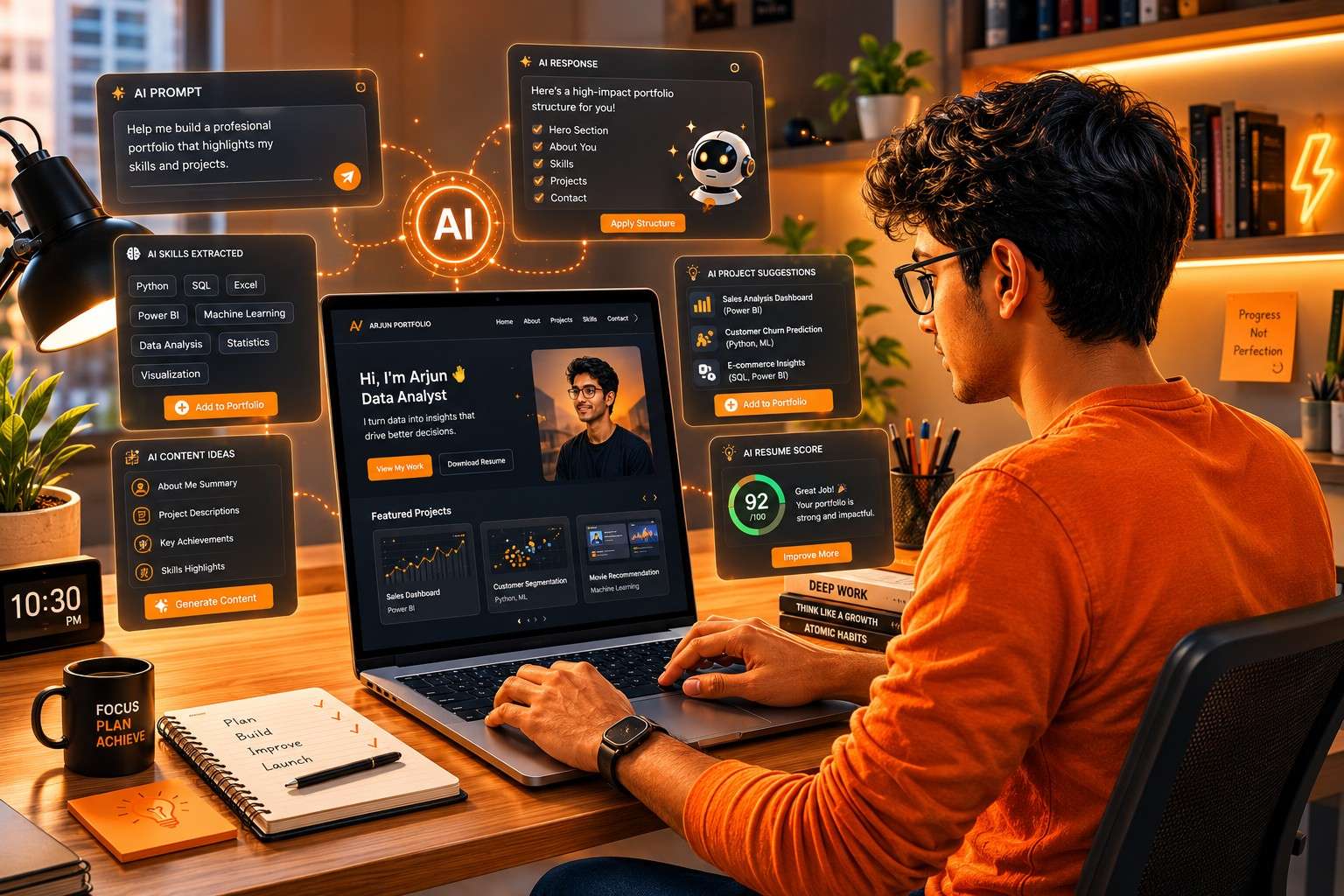
No Work Experience? Here's How AI Helps You Build a Portfolio That Gets Noticed
Most freshers are stuck in the same loop: every job asks for experience, but you can't get experience without a job. Internships go to people who already have something to show. And if you're from a college that doesn't have strong placement support, that loop feels even harder to break out of.
Here's the thing recruiters won't tell you: they don't actually care how you got your experience. They care whether you can produce something useful, a report, a campaign, a workflow, a research piece, that looks like real work. And AI now makes it possible to build exactly that, in two to three weeks, from your phone or laptop, with zero budget.
This isn't about faking anything. It's about doing real work for real purposes and documenting it properly. By the end of this, you'll have a portfolio that gives recruiters something to look at, and a story to tell in every interview.
The Core Idea Before the Examples
Before the case studies, here's the principle that makes all of this work.
Pick one role you want. Figure out what kind of output that role produces, content, reports, outreach emails, customer support scripts, research summaries. Then use AI to help you produce that output at a small scale, for a real purpose, and document everything. The result is a mini project that looks exactly like what someone in that role does every day.
Three small projects like this, presented cleanly on a Notion page or Google Drive folder, are worth more in an interview than a blank resume with a long list of skills. One is proof. The other is a claim.
Here's how five different students did this for five different roles.
Case 1: The B.Com Student Who Built a Mini Content Agency
A second-year B.Com student with no internship and no marketing experience wanted to break into digital marketing. Instead of applying and getting ignored, she built something first.
She identified three local businesses within walking distance of her college, a pan shop, a coaching centre, and a small salon. She approached each one and offered to create a month's worth of social media content for free, in exchange for a tag on their Instagram story and a one line written testimonial.
Then she got to work. For each business, she used ChatGPT to research the business, understand its audience, and generate five tailored Instagram captions. She built a ten-day content calendar for each one. She used Canva's AI tools to design fifteen to twenty static posts and wrote three Reels scripts for each business, editing everything manually to match the actual tone and personality of each place.
What she built for her portfolio: a prompt library broken down by niche, before-and-after screenshots showing the difference between their old posts and the new AI-assisted ones, and a one-page campaign summary PDF for each business covering estimated reach, what worked, and what she'd change next time.
How she described it on her resume: "Built AI-assisted social media content for three local businesses, 15 posts per client, content calendars, and performance summaries."
In interviews she said: "I treated three local businesses as my first clients. I used AI to research their audience and generate content, then edited everything to match their voice. This is exactly the workflow I'd bring to your team."
Case 2: The BBA Student Who Built a Sales Outreach System
A third-year BBA student wanted to get into sales, business development, or startup operations. He had no internship. Instead of waiting for one, he ran his own outreach experiment.
He found forty to fifty small startups on LinkedIn and Twitter that were actively growing and using AI tools. For each one, he used ChatGPT to read their homepage and write a personalised three-line opening based on their specific product and what problem he could help with. The value proposition he offered was simple: he could manage their LinkedIn content calendar using AI-assisted tools, for free, as a trial.
He tracked every email in a Notion page, noted which ones got replies, and used AI to analyse the patterns, what subject lines worked, what openers got responses, what follow-up timing made a difference. After fifty-two emails, he had seventeen replies. He turned the whole thing into a two-page case study: the system he built, the prompts he used, and what the numbers showed.
What his portfolio showed: a Notion workspace with three tabs, the full list of companies and responses, the ten prompt templates that consistently generated replies, and a "rules" document he built from what he learned about when to change the hook and when to follow up.
How he described it on his resume: "Built an AI-powered cold outreach system, 52 contacts, 17 replies, documented prompt library and playbook."
In interviews: "I treated this like an early-stage business development role. I used AI to personalise outreach at scale, tracked what worked, and built a repeatable system from it."
Case 3: The Arts Student Who Built a Customer Support System
A third-year arts student wanted to get into customer support or operations roles at a startup or an ed-tech company. She had no experience and no obvious portfolio to show.
She picked one popular Indian app with publicly available FAQs and customer complaints, a food delivery platform she used herself. She scraped common questions from their website, Reddit threads, and Google reviews. She used ChatGPT to organise them into categories, order issues, refunds, login problems, delivery complaints, and generate a hundred standardised, polite replies for each category.
She then built a simple decision flow in Notion: if a user says X, send Y; if the issue is Z, escalate to a live agent. She simulated ten real support conversations using her own script and recorded the flow with a short screen walkthrough showing how it worked and how she'd use it to train a new support agent.
What her portfolio showed: a Notion-based help centre with a knowledge base tab, a script generator tab where you paste a user query and get a suggested reply, and a short video walkthrough of the whole system.
How she described it: "Built a self-serve AI support system for a consumer app, 100+ categorised responses, decision flow, and agent training guide."
In interviews: "I documented how a support system would work from scratch using AI. I can set up, organise, and train around exactly this kind of process."
Case 4: The Student Who Turned a Local Problem Into a Research Report
A second-year BA student wanted to get into content writing or research. She had good writing instincts but nothing to show for them.
She picked one local problem she actually cared about, mental health awareness among college students in her town. She used AI to generate twenty-five survey questions, ran the survey on Google Forms with a hundred and ten respondents, and then used ChatGPT to analyse the responses and surface the three or four most consistent patterns in the data.
From that analysis, she wrote a five-page research report with an executive summary, key findings, and four specific recommendations. She turned the report into a clean eight-slide deck using Canva's AI design tools. Then she wrote a LinkedIn post explaining the whole process, how she went from a vague topic to a structured report using AI, and published it.
What her portfolio showed: the survey link, anonymised responses, her prompt history showing how she worked through the analysis, version one and version two of the report showing how AI helped her improve it, and the LinkedIn post documenting the process.
How she described it: "Led an AI-assisted research project on student mental health, 110 survey responses, five-page report, published findings on LinkedIn."
In interviews: "I can take an unstructured problem, design a research process around it, use AI to analyse the data, and communicate the findings clearly. Here's what that looks like."
Case 5: The Student Who Built a Prompt Library as a Portfolio
A student who wasn't sure which direction to go in, but knew they wanted to work in an AI adjacent role, spent thirty days building something specific.
For the first ten days, she built one prompt bank per day, a Twitter thread generator, a LinkedIn post writer, a resume tailoring assistant, a cold email builder, a content calendar creator. For the next ten days, she tested each prompt on three to five real examples: friends' resumes, actual posts, real outlines. She noted what worked, what needed adjustment, and why.
For the final ten days, she compiled everything into a "Prompt Operations Handbook", her ten best-performing prompts, each with a clear input-output format and one real before-and-after example. She made it public on Notion and added a short video walking through one prompt from raw input to final output.
What her portfolio showed: a clean, organised Notion page with a prompt library section and a case studies section. Each case study showed the original input, the prompt she used, and the final result, with a brief note on why it worked.
How she described it: "Built a 30-day prompt operations project, ten production-ready prompts with documented inputs, outputs, and real-world case studies."
In interviews: "I can take any repetitive output task, build a reliable prompt for it, test it on real examples, and document the process so anyone on a team can use it."
How to Put This Together in One Place
All five of these students had the same thing in common: they put everything in one place and made it easy to find.
A simple Notion page or Google Drive folder with three to five project sections is enough. Each section needs a one-line description of what the project was, the role it's relevant to, two or three screenshots or samples of the actual output, and a brief note on the tools and process used. That's it. Drop the link in your resume under a "Projects" section and mention it in every interview.
The goal is not to impress anyone with complexity. The goal is to make it easy for a recruiter to look at something you made and think, this person can actually do the work.
Where to Start
Pick one role from the five cases above, the one that feels closest to what you want. Then do this:
Day one: identify your subject. A local business, an app you use, a problem in your college, a set of tasks you want to build prompts for.
Day two: spend thirty minutes producing one small output with AI. A caption, a support reply, a survey question, a research summary. Something real.
Day three: save version one and version two. Write one line about what changed and why.
By the end of the week you'll have the beginning of a portfolio project. By the end of the month, you'll have something worth putting on a resume, and a story worth telling in an interview.
The loop doesn't break by waiting for an internship. It breaks when you build something.
The gap is growing every day.Close it.
Download Project Shift free and start your first lesson today.
Download FreePlans start at just ₹4,999/year ₹999/year